
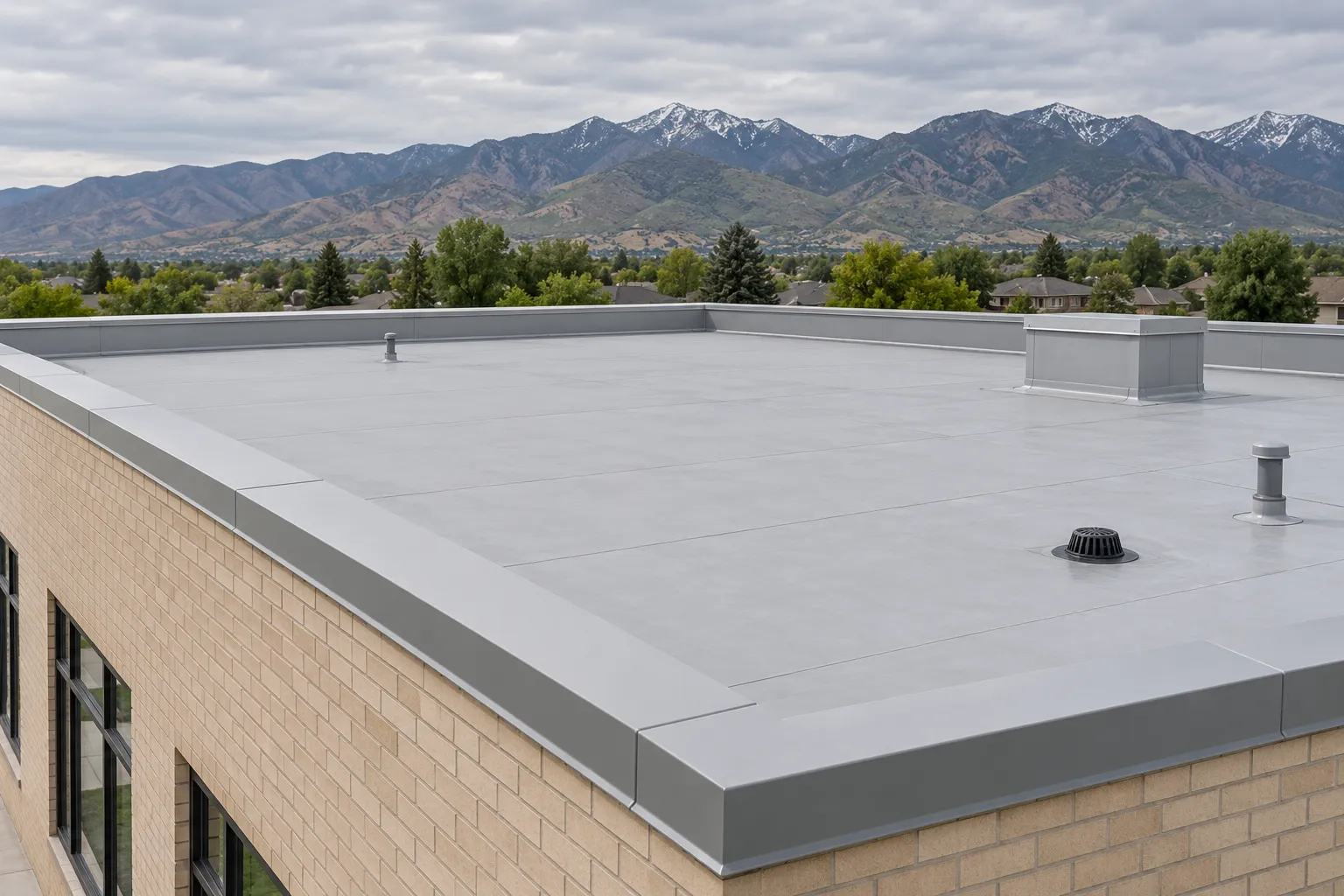
Commercial Roofing / Davis & Weber counties
Plan the roof around the building beneath it.
For owners and property managers: understand drainage, access, tenant impact and roof-system scope before deciding on commercial roof work.
Commercial roof decisions need to account for the building, not just its covering. Roof type, drainage, equipment, access restrictions and tenant operations influence an assessment and the options that follow. Actual system capability and project availability must be confirmed before work is agreed.
Begin with the existing system.
Identify the roof assembly, approximate age, past repairs and any available drawings or warranty records. A membrane, metal or modified-bitumen system has different details and maintenance needs.
A visual review alone may not establish insulation condition or moisture below the covering. If testing is proposed, ask what it will establish and how the roof will be made weather-tight afterward.
Make drainage and penetrations part of the scope.
Ponding, blocked drainage, deteriorated flashing and equipment penetrations can affect performance. The cause should be identified before a coating or patch is selected.
Access to drains, roof hatches and mechanical areas must be planned safely. Coordinate with facility staff and any equipment contractor when the work affects their systems.
- Roof type, deck and insulation information
- Leak history and drainage concerns
- Equipment, curbs, penetrations and access
- Tenant hours and protection of occupied areas
- Scope limits, diagnostics and written closeout
Compare repair, restoration and replacement.
A repair may be appropriate for an isolated defect. Restoration or a coating may be suitable only for certain sound, compatible assemblies. Replacement may be necessary where damage or system condition prevents a reliable smaller intervention.
These options are not interchangeable. Ask what condition makes the proposed approach suitable, what preparation is included and what exclusions apply. Do not assume that a new surface resolves trapped moisture or a drainage design problem.
Coordinate work with the people using the building.
Discuss deliveries, odors, noise, equipment shutdowns, occupied entrances, parking and weather protection. A site plan and communication contact can prevent avoidable disruption.
Confirm the permit authority and required inspections for the property. Work on a city property should not be routed to an unincorporated-county process simply because it lies in the same county.
Confirm capability and warranty responsibility.
TPO, EPDM, PVC, coatings and specialty metal work require different product and installation knowledge. Verify that the proposed contractor can perform the exact scope.
Manufacturer eligibility, inspection requirements and workmanship coverage depend on actual documents. No membrane certification, industrial project history or warranty is implied by this information page.
Useful questions
Before you decide.
Can a coating fix every commercial roof leak?
No. The existing assembly must be suitable, sound and compatible. Drainage, moisture and underlying damage require assessment before a coating is considered.
What information helps a commercial roof estimate?
Roof plans if available, system and warranty records, leak history, equipment/access restrictions and tenant operating requirements.
Does the website confirm a contractor for a specific system?
No. Contractor capability, current availability and the exact project scope must be confirmed before an appointment or work is agreed.
Your next step
Let's start with your roof.
Share the property and the question. Confirm the scope before committing to work.